Competencies
Professional Skills
Communication Clear written and verbal communication across academic, technical, and public-facing audiences.
Collaboration Experienced working in multidisciplinary teams across engineering, ecology, and remote sensing.
Leadership Led undergraduate research teams; coordinated project timelines, deliverables, and mentorship.
Project Management Managed grant-funded research from data collection through publication with multiple concurrent workstreams.
Mentorship Trained and supervised undergraduate researchers in technical skills, research methodology, and scientific writing.
Intercultural Competence Worked with diverse international collaborators; experienced in cross-cultural academic and professional settings.
Critical Thinking Comfortable working with ambiguous datasets; draws defensible conclusions from incomplete or noisy evidence.
Adaptability Pivoted methodologies mid-project based on new data availability, equipment failure, and evolving research goals.
Languages
BengaliNative
EnglishAdvanced
FrenchIntermediate
Teaching & Mentoring
Syllabus & Curriculum Design Course Instruction NSF REU Supervision Honors Thesis Advising Independent Research Mentorship Remote Sensing Training (GEE, R, Python) Eddy Covariance Data Processing (EddyPro) GIS Training (ArcGIS, ModelBuilder) Senior Design Project Supervision Grading & Recitation Support
Scientific Communication
Peer-Reviewed Journal Articles Conference Presentations Technical Data Documentation Research Group Meetings Grant Reporting Public Outreach
Programming & Software
Languages
- Python
- R
- JavaScript (Google Earth Engine)
- LaTeX
GIS & Remote Sensing
- QGIS
- ArcGIS & ModelBuilder
- Google Earth Engine
- Sentinel-5P Analysis
Flux & Field Data
- EddyPro
- AmeriFlux Data Standards
- Campbell Scientific Software
- LI-7500 / LI-7700 Calibration
- Campbell Sonic Anemometer
General Software
- Microsoft Office Suite
- Git / GitHub
Data Analytics & Modeling
Geospatial & Time Series
- Geospatial Analysis
- Time Series Analysis
- Harmonic Function Analysis
- Descriptive Statistics
Machine Learning
- Random Forest
- XGBoost
- scikit-learn
- Linear & Non-Linear Regression
- Double Logistic Regression
- GAM Regression
Process-Based Models
- Vegetation Photosynthesis Model (VPM)
- Carbon Flux Partitioning
- NEE Gap-Filling
Published Data & Code
Cumulative GPP Data of Rice in Arkansas (500 m Resolution)
Riasad Bin Mahbub · Michele Reba · Benjamin Runkle
High-resolution dataset of Arkansas rice regions (2008–2020) including crop frequency, county shapefiles, environmental variables (temperature, PAR), MODIS indices (EVI, LSWI), and GPP modeled with VPM across six rice ecological zones.
Carbon Flux Partitioning & NEE Gap-Filling — Arkansas Rice Fields
Riasad Bin Mahbub
Eddy covariance flux data processing scripts for gap-filling net ecosystem exchange (NEE) and partitioning gross primary productivity (GPP) and ecosystem respiration at the landscape scale, following AmeriFlux standards.
Rice Planting & Harvest Date Prediction — Arkansas (Satellite + ML)
Riasad Bin Mahbub
Code and analysis for predicting rice planting and harvesting dates across Arkansas using satellite imagery time series and machine learning algorithms, supporting phenological monitoring at the state scale.
GEE Script — Mapping Crop Rotation & Monoculture Patterns
Google Earth Engine · USDA Cropland Data Layer (CDL) 2008–2020
Identifies and visualizes crop rotation patterns using the agkit4ee module. Detects monoculture and rotation sequences (e.g., rice–soybean, corn–soybean) for major crops and outputs color-coded map layers showing cropping patterns across the agricultural landscape.
GEE Script — Modeling 2020 Crop Frequency & Intensity Across Arkansas
Google Earth Engine · USDA Cropland Data Layer (CDL) 2008–2020
Models and visualizes the 2020 spatial distribution and frequency of corn, cotton, rice, soybean, wheat, and double-cropped wheat–soybean systems. Produces color-coded frequency maps, rice distribution histograms, and exports per-crop intensity layers to Google Drive as GeoTIFFs.
Research Experience
- Mapped and analyzed industrial symbiotic networks to identify resource efficiency opportunities across industrial clusters.
- Identified and characterized air pollution hotspots across Bangladesh using spatial analysis techniques.
- Performed lifecycle-based economic and environmental assessments of green infrastructure systems.
- Investigated sea turtle nesting patterns, beach profiles, and land cover dynamics along the Bay of Bengal coastline.
- Authored a report on shark conservation status in Bangladesh.
Industry & Policy Relevance
Growing regulatory pressure and corporate sustainability mandates have created strong demand for environmental scientists who can bridge academic research and applied decision-making. Two recent pieces in Nature frame this shift directly — and highlight skills that align closely with this portfolio.
Nature · Comment · 2026
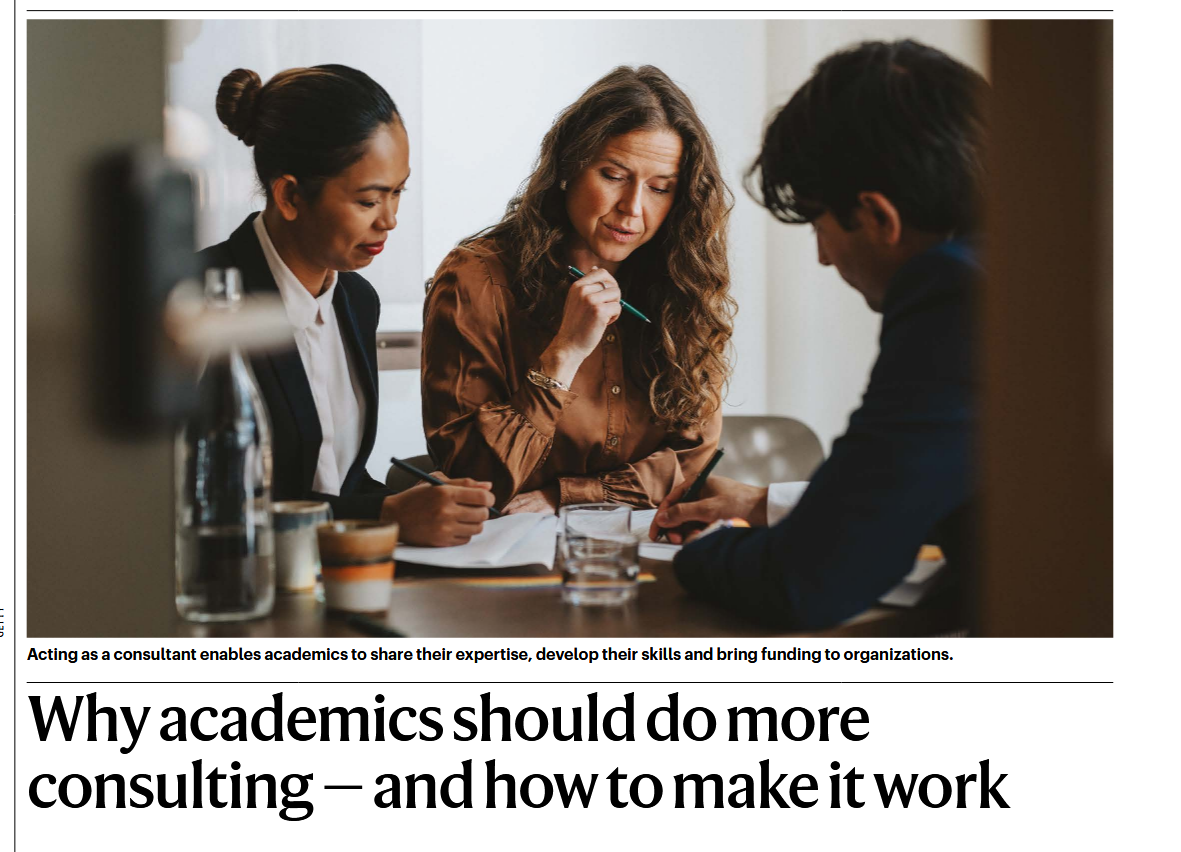
Why Academics Should Do More Consulting — and How to Make It Work
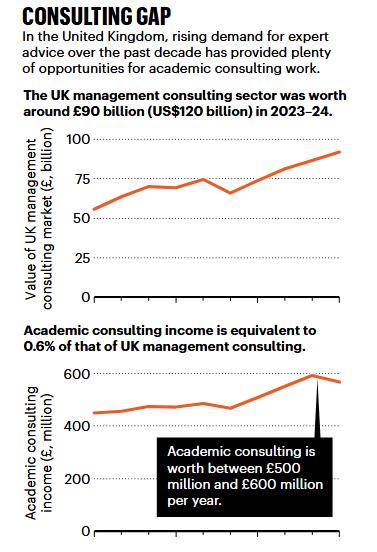
The UK management consulting sector reached £90 billion (US$120B) in 2023–24. Academic consulting — worth £500–600M/year — represents just 0.6% of that market, signaling a large unmet demand for expert scientific advice in industry and policy.
Read in Nature ↗Nature · Data · 2026
The Consulting Gap: Rising Demand for Expert Advice
Over the past decade, rising demand for expert advice has created abundant opportunities for academic consulting work. The gap between available scientific expertise and industry uptake represents a structural opportunity for researchers with applied skills.
Read in Nature ↗Nature Sustainability · Comment · 2024
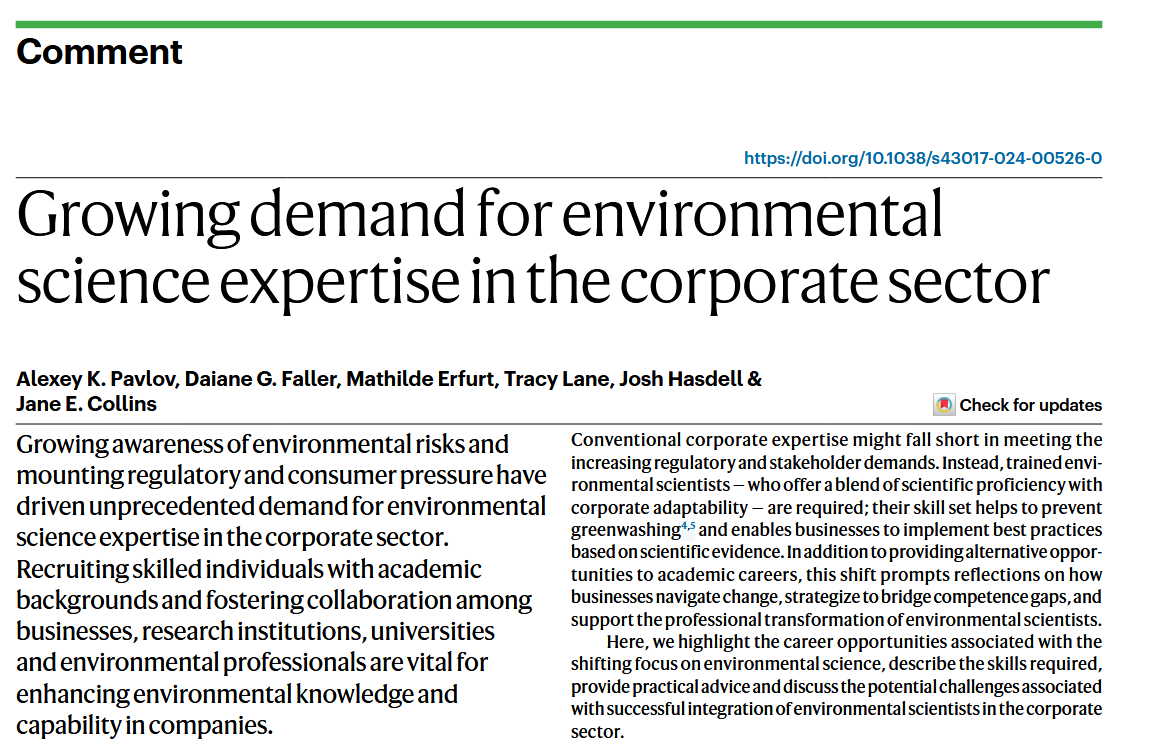
Growing Demand for Environmental Science Expertise in the Corporate Sector
Pavlov et al. argue that trained environmental scientists — combining scientific proficiency with corporate adaptability — are uniquely positioned to prevent greenwashing and help businesses implement evidence-based sustainability practices.
Read in Nature Sustainability ↗ These articles identify a concrete set of competencies that environmental scientists need to be effective in corporate and policy contexts. The skills below map directly to those frameworks:
Science–Policy Translation Translating complex remote sensing and flux model outputs into clear, actionable findings for non-specialist stakeholders — grant agencies, collaborators, and resource managers. Pavlov et al. 2024
Evidence-Based Decision Support Building defensible quantitative models (VPM, Random Forest, GAM) grounded in peer-reviewed methodology, directly applicable to carbon accounting and environmental monitoring. Pavlov et al. 2024
Carbon & GHG Accounting Hands-on experience estimating CH₄ and CO₂ fluxes at field and state scale — directly relevant to corporate sustainability reporting and Scope 3 emissions tracking. Corporate Sustainability
Stakeholder Communication Presented research to diverse audiences including funding agencies (NASA, USGS, NSF), conference attendees, and academic journals — core to effective consulting engagement. Lee 2026
Applied Geospatial Analytics State-scale spatial modeling using GEE, ArcGIS, and MODIS/Landsat/Sentinel imagery — directly applicable to land use analysis, environmental due diligence, and ESG reporting. Pavlov et al. 2024
Interdisciplinary Adaptability Worked across engineering, ecology, agronomy, and data science — the cross-disciplinary fluency that Pavlov et al. identify as essential for scientists entering the corporate sector. Pavlov et al. 2024
 Web of Science